
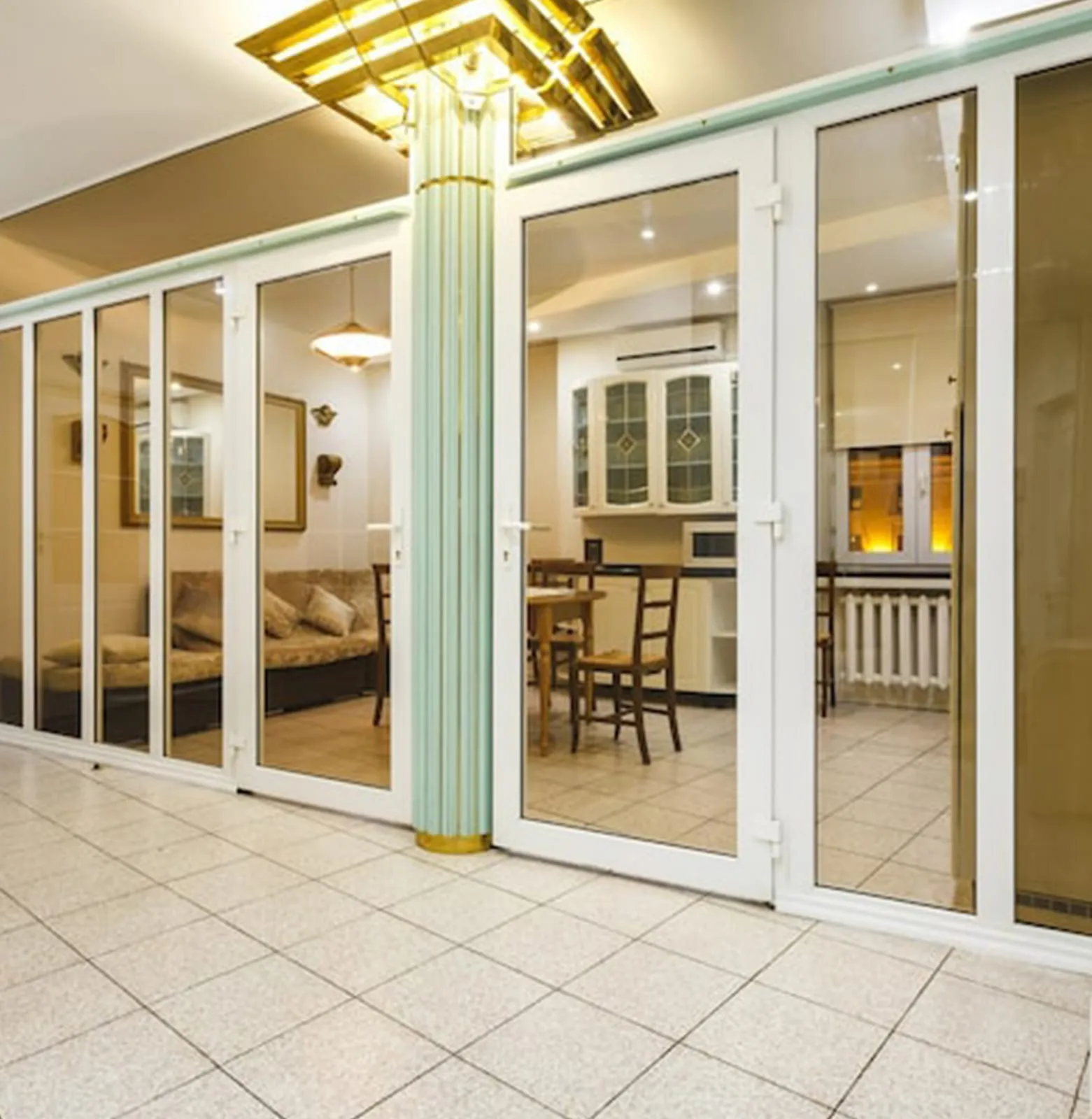
What you get and what it costs you
You get the whole opening. Panels fold against each other and stack against the jamb, so what remains is the stack depth rather than a parked panel across half the aperture. No other system does this.
You pay for it in complexity. More panels mean more hinges, more carriages, more track and more joints between leaves. Each of those is a component that needs to stay adjusted and a potential air and water path.
That trade is worth making where the opening is the main event — a living room onto a terrace, a restaurant frontage, a room that needs to open up for entertaining. It is not worth it on a modest balcony opening, where a slider or a lift-and-slide does the job for less.
Configuration
Panel count. More panels give a narrower stack depth but add cost and complexity. The opening width sets a sensible range and the stack position narrows it further.
Stacking direction. All to one side, or split both ways. Splitting keeps the stack shallow at each jamb; stacking one way keeps one side completely clear.
A traffic door. One leaf configured to open independently on its hinges, so you can step out without folding the set. On any door used daily, this is close to essential.
Inward or outward folding. Outward keeps interior floor space clear but needs terrace depth for the stack. Inward keeps the stack sheltered but consumes room space.
Thresholds, which matter more here
A folding system has more track and more panel joints than any other door type, so the threshold is doing more work.
- a weathered upstand so water cannot cross under the panels
- a drained channel running the whole length of the track
- outlets sized for monsoon volume, with somewhere for the water to actually go
- gaskets on every panel joint as well as at the perimeter
Low-threshold details are possible and popular, but the drainage has to be designed rather than reduced. This is the single decision that determines whether a bi-fold works in a Mumbai monsoon.
Keeping it working
Two things:
Keep the track clear and level. Grit in the track is what wears carriages, and a track that is not level means panels that do not fold or close squarely. Levelling is done at installation and checked at service.
Keep the drainage open. Silted outlets turn the drained channel into a reservoir.
Both are covered under door service and repair.
Glass
Large panels at floor level, so laminated or laminated-toughened throughout. On a west or south-west terrace, a solar-control coating is worth the difference — a fully glazed folding wall facing the afternoon sun is a large heat aperture. See glass options.