
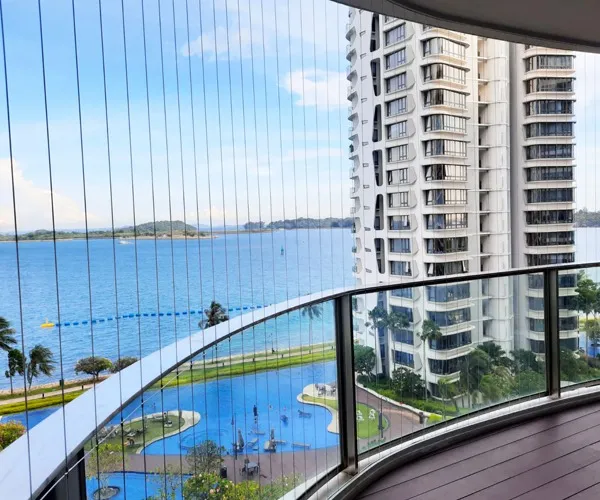
Why cable instead of bars
A traditional grill does the safety job and takes something away in exchange: the view is cut into sections, the balcony feels enclosed, and airflow drops. In a city where the view and the breeze are a large part of what a flat is worth, that is a real cost.
Tensioned cable does the same job with a fraction of the visual weight. You look through it rather than at it.
There is also a safety argument that runs the other way from expectation. Traditional grills frequently have bar gaps wide enough for a small child or a cat to get through. The closely spaced wires of a properly specified invisible grill do not.
The three things that decide whether it is safe
Material grade. Marine-grade stainless for the cable and every fitting. In coastal Mumbai the fittings corrode first, and rust staining down a wall is the visible symptom of a system that is also losing strength.
Tension and anchoring. Cables must be tensioned correctly and anchored into structure that can take the load. On older balconies, where the parapet or slab edge has been repaired or re-screeded, that has to be checked rather than assumed. This is why we survey before quoting.
Spacing. Set to safety standards, not to what looks tidy.
The systems we make
Vertical wire. Cables running floor to soffit. The standard, and visually the lightest.
Horizontal wire. Cables running side to side, for openings where the anchors are better placed at the jambs.
Cable mesh. A woven stainless mesh rather than parallel cables, for the highest safety requirements and for pets that climb.
Framed. Cables within their own aluminium frame, fixed into the opening. Useful where the structure cannot take direct anchors.
Frameless. Anchors direct into the structure, for the cleanest possible result.
Sliding. A section that slides aside, where part of the run has to open — for access, or for cleaning the outside of the glazing behind it.
Where they are fitted
Balconies are the main case, and the one people ask about — see invisible grills for balconies in Mumbai. But the same systems are used on window openings above ground floor, on internal stair and mezzanine voids, on terrace edges, and across service shafts.
Invisible grills or glass railings?
They solve overlapping problems differently. Glass railings give a solid, weather-blocking edge treatment with an uninterrupted view, at higher cost and with more structural demand. Invisible grills give fall protection with airflow, at lower cost and lower visual weight.
On many balconies the honest answer is one or the other; on some, a glass balustrade at the edge with an invisible grill above it is what the brief actually needs.
Send the balcony width, the floor, and a photo of the parapet and soffit, and we will tell you which system fits.