
Skip to content
Khidkiji Slides India

Door Types

Door type is a decision about how much of the opening clears, how well it seals, and how much room the leaves need to go somewhere. Those three trade off against each other, and the right answer depends on the opening rather than on preference.

  • Manufacturing since 2007
  • 5,000+ windows installed
  • 219 corporate partners
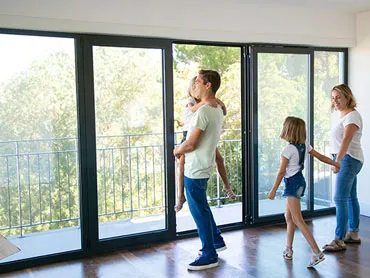
Family walking through wide sliding glass doors from a living room onto a balcony

Get a quote in one working day

Three fields. No obligation.

Or call +91 80979 88888

Why door types

Matched to the opening

Width, floor space and what the door faces decide the type before style does.

Every system made in-house

Sliding, lift-and-slide, folding, French and entrance doors fabricated in Bhandup West to your survey.

uPVC and aluminium

uPVC for insulation and value, aluminium for slim sightlines and wide spans.

Thresholds designed for monsoon

Every type detailed with a drained, weathered threshold rather than a flat sill.

Sliding doors

Panels glide horizontally along a track instead of swinging, so nothing projects into the room or over the balcony. That makes them the default for Mumbai flats, where floor space is tight and balconies are narrow.

The trade-off is that one panel always covers part of the opening, and that a slider seals by proximity and brush strips rather than compression. Full detail on sliding doors.

Lift and slide doors

A sliding system with a lifting mechanism. Turning the handle raises the panel clear of its gaskets so even a very heavy leaf glides with light pressure; turning it back lowers the panel onto the seals and locks it.

That single mechanism solves the slider’s main weakness. A closed lift-and-slide compresses its gaskets like a hinged door, so it seals against rain and noise far better than a standard slider — which is why it is the right specification on a large, exposed or road-facing opening. See lift and slide doors.

Slide and fold doors

Also called bi-folds. Multiple panels run on a track and fold concertina-style to one or both sides, so nearly the whole opening clears.

This is the type to choose when you want the room and the terrace to become one space. The requirements are somewhere for the stacked panels to sit, a track set dead level, and threshold drainage sized properly. See slide and fold doors.

Casement and French doors

A pair of side-hinged leaves meeting in the centre with no mullion, so the full width between jambs clears. Hinged leaves compress a gasket all round, which makes them the best-sealing option of the four, and they suit narrower openings where a sliding track would be wasted.

They need swing space, inside or out. See casement French doors.

uPVC entrance doors

Solid or part-glazed leaves for main entrances and utility doors, with multi-point locking and reinforced profiles. The emphasis here is security and weather sealing rather than clear opening. See uPVC doors.

Choosing

Three questions settle it in most cases:

  1. How much of the opening has to clear? All of it means folding; some of it means sliding; the full width between jambs means French.
  2. Is there floor space for a leaf to swing? If not, sliding or folding.
  3. Does it need to seal well? If the opening faces a main road or takes driven rain, lift-and-slide or hinged, not a standard slider.

Materials follow afterwards: uPVC for insulation and value, aluminium for slim sightlines and wide spans. For how any of these are fitted, see door installation.

Common questions

Which door type is best for a Mumbai balcony?

A slider where floor space is tight, which covers most balconies. A lift-and-slide where the panel is large and sealing matters, because it drops onto its gaskets when closed. Slide-and-fold where you want the entire opening clear and have somewhere for the stacked panels to sit.

What is the difference between a sliding door and a lift-and-slide?

A standard slider runs on rollers and seals by proximity. A lift-and-slide lifts the panel clear of its seals to move and lowers it back onto them to close, which gives a far better weather and acoustic seal — and lets a very heavy panel move with one hand.

How much of the opening does each type actually clear?

A two-track slider clears about half. A three or four-track slider clears more. Slide-and-fold clears nearly all of it, since the panels stack to one side. French doors clear the full width between jambs. Hinged single doors clear their own leaf width.

Which door type seals best?

Lift-and-slide and hinged types. Both compress a gasket when closed — a hinged leaf by its multi-point lock, a lift-and-slide by lowering onto its seals. Standard sliders and folding doors seal by proximity and brush strips and are inherently leakier.

Do folding doors work in Mumbai's climate?

Yes, with two conditions: the track must be set dead level and kept clear, and the threshold drainage must be designed for monsoon volume. A folding system has more track and more leaves than a slider, so it needs more attention on both counts.

Related

Get a quote for door types

  • Manufacturing since 2007
  • 5,000+ windows installed
  • 219 corporate partners
Call nowWhatsApp