
The question behind the question
Nobody researches balcony grills for fun. It is almost always one of three things, and which one it is changes the answer:
A child who has just become mobile. The urgent case, and the one with the least patience for a long lead time. Vertical cables, spaced to standard, with no horizontal line anywhere in the reachable zone.
A cat. Different problem entirely. Cats climb vertical cables and squeeze through spacings that stop a toddler, so the honest answer is usually cable mesh rather than parallel wires. Owners regularly discover this after the parallel system is already fitted.
A society circular. Many Mumbai buildings now require balcony protection, often with a deadline and sometimes with a specified appearance. Worth reading the circular before choosing, because some prescribe a colour or a fixing method.
Why cable rather than bars
A traditional grill does the safety job and takes something in exchange: the view arrives in sections, the balcony feels enclosed, and airflow drops. In a flat where the view and the breeze are a real part of what you paid for, that is a genuine cost.
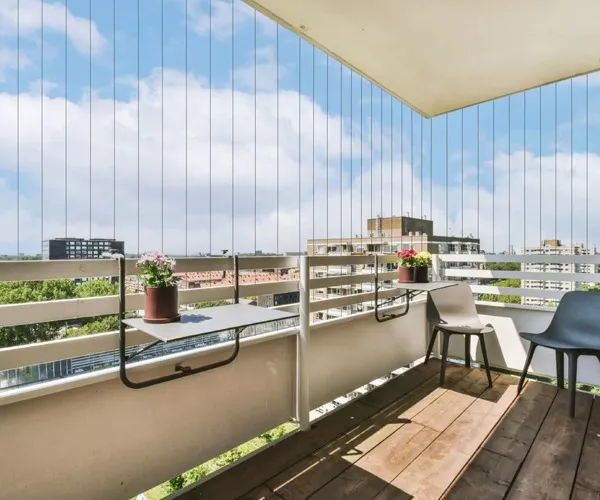
Tensioned cable does the same job at a fraction of the visual weight. From a few feet away you look through it rather than at it.
There is also a safety argument that runs opposite to intuition. Barred grills often have gaps wide enough for a small child or a cat to pass. Correctly spaced cable does not.
What your balcony has to offer
This is what a survey is actually establishing, and it is where quotes given over the phone go wrong.
Something sound to anchor into. Cables are tensioned, so the anchors carry real load. On older Mumbai balconies, parapets have often been rebuilt, slab edges re-screeded, and waterproofing layers added — 40 mm of make-good over something older will not hold an anchor. Where the structure is uncertain, a framed system spreads the load onto fewer, better-chosen points. That is the right answer, not a downgrade.
A soffit, or usable side walls. Vertical cables need the slab below and the soffit above. An open terrace with nothing overhead needs horizontal cables between the flanking walls instead — with the caveat that closely spaced horizontals give a climbing child footholds, so they are the wrong choice where a toddler is the reason for fitting.
A way to get out. If you need to clean the outside of the glazing behind the grill, or reach an air-conditioning condenser, say so at survey. A sliding section is straightforward to build in and close to impossible to add afterwards.
The thing that decides how long it lasts
Not the cable. The fittings.
Mumbai’s coastal air attacks anchors, tensioners and end caps long before it touches the wire, and the first symptom is rust staining running down your parapet. Marine-grade stainless throughout is not an upgrade on this coast — it is the difference between a system that looks right in ten years and one that stains the wall in three.
It is also the easiest place for a cheap quote to save money invisibly, because a lower-grade fitting looks identical on the day it is installed.
Living with it
Check the tension once a year — cables should feel taut with no visible sag. A slack cable is re-tensioned in seconds and puts extra load on its neighbours if it is left. Wipe the cables when you clean the balcony. That is the whole maintenance routine.
Or something else entirely
If what you actually want is a solid edge that blocks wind and rain as well as falls, glass railings do that and invisible grills do not. On some balconies the right answer is a glass balustrade at the edge with a grill above it.
Send the balcony width, the floor number, and a photo showing the parapet and the soffit. That is enough to tell you which of the six systems fits and whether the structure will take it. The full range covers how they differ.