
Skip to content
Khidkiji Slides India

Pipe and Tube Fabrication

Hollow sections are efficient in torsion, clean to look at from every angle, and harder to fabricate than open sections. Where a structure will be exposed — a canopy, an atrium frame, a balustrade — tube is usually what it should be made from, and profiling the joints is where the work is.

  • Manufacturing since 2007
  • 5,000+ windows installed
  • 219 corporate partners
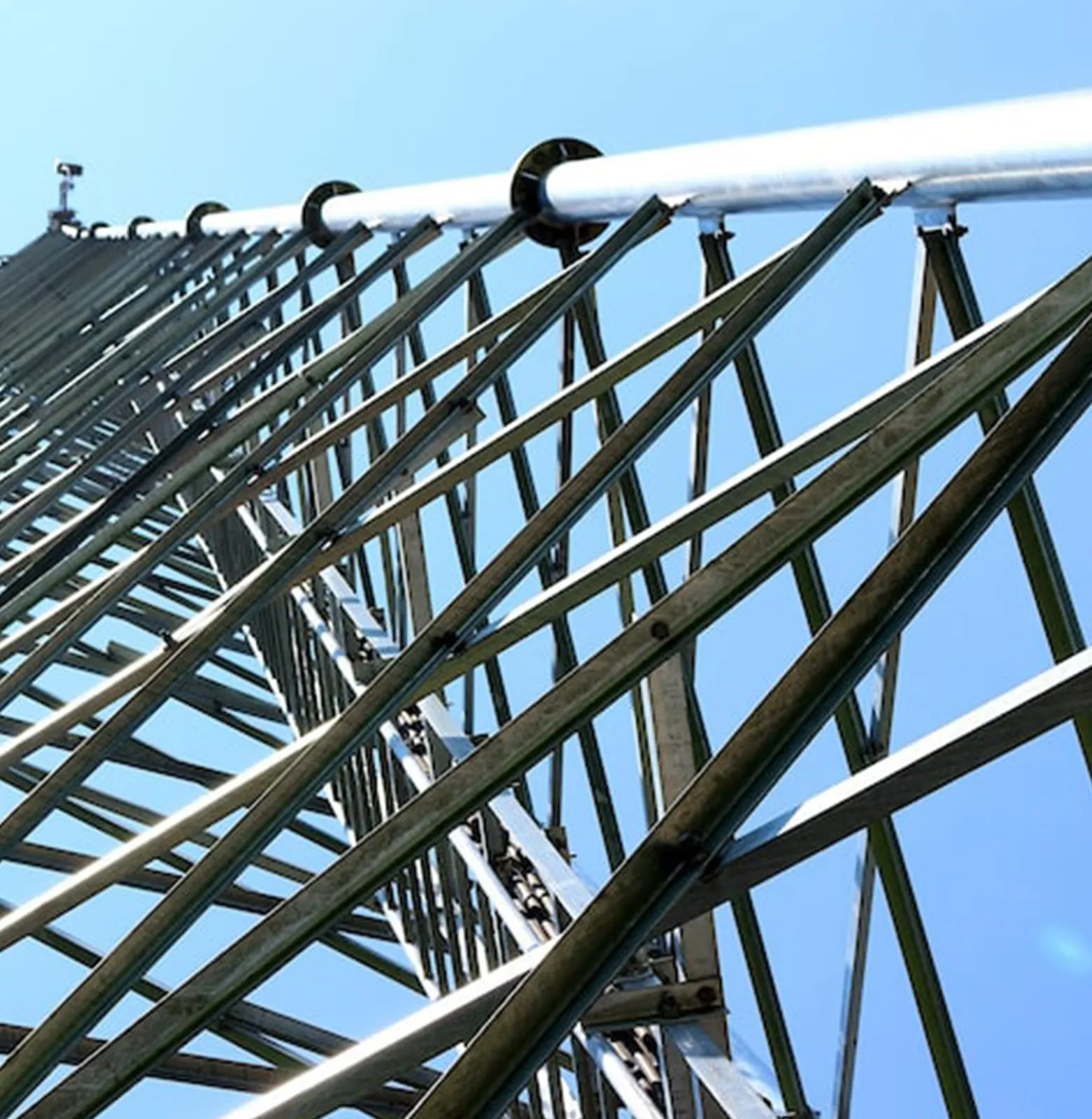
Curved tubular steel roof frame seen from below, members converging overhead

Get a quote in one working day

Three fields. No obligation.

Or call +91 80979 88888

Why pipe and tube fabrication

Efficient in torsion and buckling

A closed section resists twist far better than an open one, which matters on canopies and long spans.

Reads well from every angle

No flanges or webs to catch the eye, so an exposed frame looks intentional rather than structural.

Profiled joints, not flattened ends

Tube ends cut to the intersecting curve so members meet cleanly — the detail that separates good tube work.

Sealed against internal corrosion

Ends closed or vented deliberately, because a hollow section that traps water corrodes from the inside out.

Why tube

Torsional stiffness. A closed section resists twist far better than an open one. On a cantilevered canopy, a curved frame or anything loaded off its axis, this frequently governs the design.

Buckling resistance. A hollow section has the same radius of gyration in both directions, so a tube column is efficient where an I-section would need bracing about its weak axis.

Appearance. This is the reason most of our tube work exists. Exposed, a tube reads as a clean line from every angle. An I-beam reads as flanges and a web, and looks different depending where you stand.

Profiling the joints

The defining skill in tube fabrication.

Where one tube meets another, the end has to be cut to the curve of the intersection — a saddle cut — so the two fit closely before welding. Done properly, the members appear to grow into each other.

The alternatives are visible compromises: flattening the tube end, notching it crudely, or leaving a gap filled with weld. All three are weaker and all three look wrong on exposed work.

Profiling is why tube joints take longer to prepare than open-section connections, and why welding quality matters more — the weld is usually visible.

Internal corrosion

The failure mode specific to hollow sections, and the one people forget.

If water gets inside a tube and cannot get out, it corrodes the section from the inside where nobody can inspect it. In coastal Mumbai, with driven monsoon rain, this happens readily.

Two valid approaches:

Seal it completely. Ends capped and welded, so nothing enters. Requires that no penetration anywhere lets water in.

Vent and drain it deliberately. Holes positioned so water that enters can leave, and air can circulate. Essential if the section is to be galvanised, since the bath needs to fill and drain.

What is not valid is leaving open ends and hoping. See steel fabrication for how protection is specified.

Bending

Tube can be rolled to a curve, or induction bent for tighter radii and larger sections.

The constraint is the minimum radius achievable without distorting or wrinkling the section. That figure depends on the diameter and wall thickness, and it has to be established before the geometry is finalised — a curve drawn without reference to it may simply not be makeable in that section.

Where we use it

Entrance canopies and porte-cochères, support structures for glazed roofs, atrium and structural glazing support frames, balustrade posts and handrails, and exposed architectural frames generally.

See the full structural fabrication range for how tube work fits alongside plate and open-section fabrication.

Common questions

Why use hollow sections instead of I-beams?

Torsional stiffness and appearance. A closed section resists twisting far better than an open one, which matters on canopies, curved frames and anything loaded off its axis. Exposed, it also looks much cleaner — there are no flanges and webs to read as structure.

What is profiling in tube fabrication?

Cutting the end of a tube to the curved shape of whatever it meets, so the members fit together closely before welding. The alternative — flattening or crudely notching the end — is weaker and looks like a compromise. On exposed work, profiling is the difference between good and poor.

Do hollow sections corrode inside?

They can, badly, if water gets in and cannot get out. Ends must be sealed properly, or drainage and venting provided deliberately. In coastal Mumbai an unsealed tube that collects rainwater will corrode from the inside where nobody can see it.

Can tube be bent to a curve?

Yes, by rolling or induction bending depending on the radius and section size. Tight radii and large sections need induction bending. The radius achievable without distorting the section is a real constraint and is established before the design is finalised.

Is tube fabrication more expensive than open sections?

Generally yes — the material costs more and the joints take longer to prepare. It is specified where the structure is exposed, where torsional performance is needed, or where a curved geometry is required. For a concealed frame, open sections are usually the economical answer.

Related

Get a quote for pipe and tube fabrication

  • Manufacturing since 2007
  • 5,000+ windows installed
  • 219 corporate partners
Call nowWhatsApp