
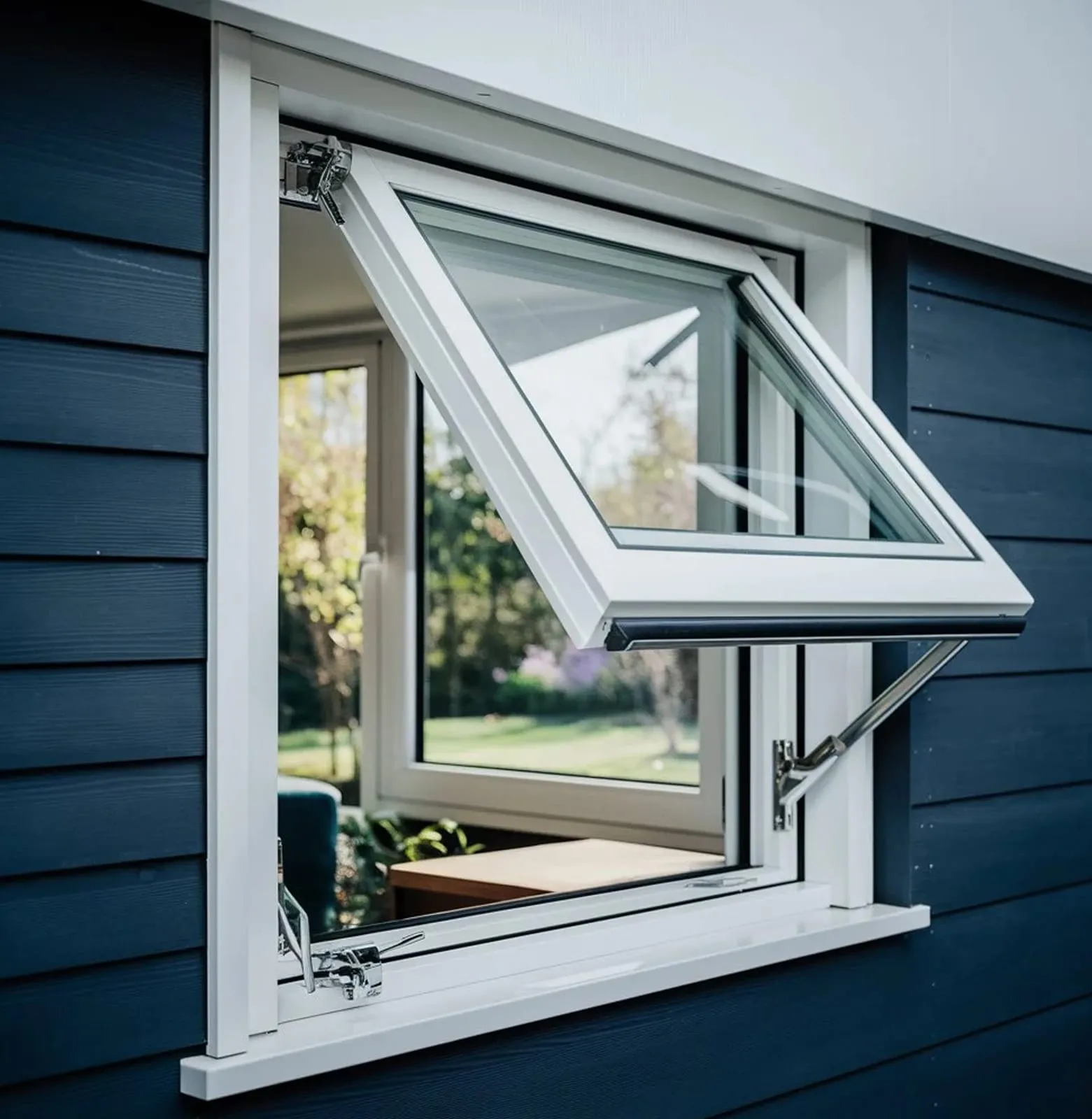
The monsoon argument
Most window types force a choice during the rains: closed and stuffy, or open and wet. A top-hung sash does not, because it projects over its own opening and throws water clear.
That makes it the practical answer for the rooms that most need continuous ventilation in humid weather — bathrooms, kitchens, utility areas — where shutting the window for four months causes its own problems with damp and smell.
It is also why top-hung windows are so common at high level in Mumbai buildings: they can be left open and forgotten.
Ventilation out of proportion to the opening
A top-hung sash open by a few centimetres moves a surprising amount of air, because the opening is a full-width slot along the bottom edge and the projecting sash induces flow over it.
Two consequences follow:
Security. You can fit restrictors that leave a gap too narrow to reach through and still get useful ventilation. A casement or slider ventilating the same amount would be wide open.
Comfort. Air enters along the sill and rises, rather than blowing directly at whoever is sitting nearby.
Sealing
Like any hinged window, a top-hung sash compresses a gasket all the way round when it closes, which is inherently better sealing than a slider, where the sashes seal by proximity and brushes. If a room needs to be genuinely quiet and airtight when shut, hinged beats sliding every time.
Hardware is the thing to specify carefully. The sash hangs from its top hinges and is held by friction stays that must both support it at any opening angle and resist wind slamming it. Cheap stays sag and the sash drops open.
Clearance is the constraint
The sash swings outward, so it needs clear space. In practice the things it fouls are:
- security grills and invisible grills fitted close to the opening
- externally mounted insect screens — which is why screens for top-hung windows go on the inside
- parapets, ledges and neighbouring pipework in a light-well
- awnings and chhajja projections
We check this at survey, because it is the single most common reason a top-hung window has to become something else.
Where it fits in the range
Top-hung windows are rarely the whole answer for a room; they are usually the ventilation element alongside a fixed light or a casement. In a kitchen, one top-hung sash above the counter plus a fixed pane beside it is a common and sensible arrangement.
For screens that work with an outward-opening sash, see insect screens. For the full range of operations, see window types.