
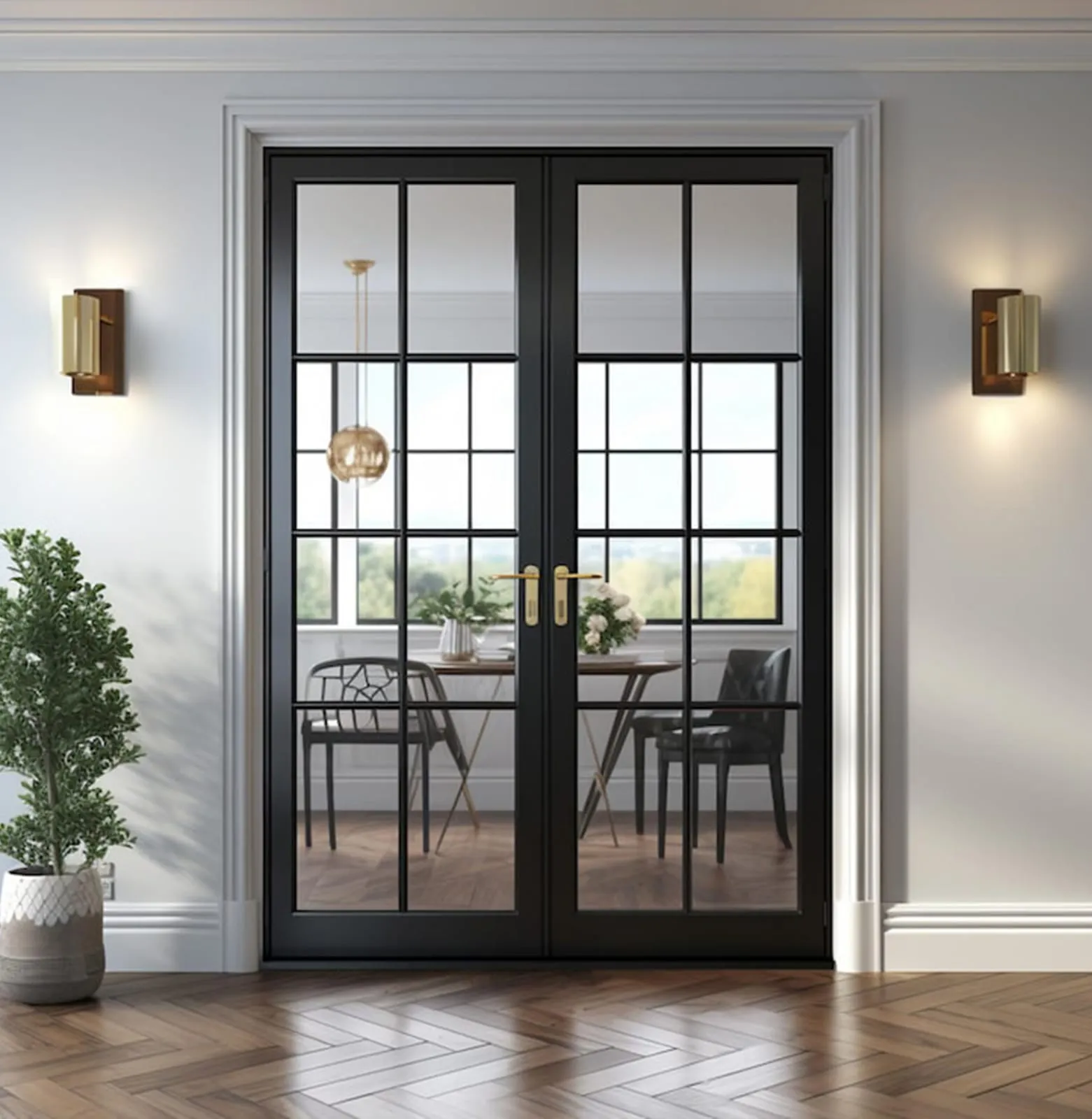
What defines the type
Two leaves, hinged on their outer vertical edges, meeting at the centre. One is the master, carrying the handle and multi-point lock. The other is the slave, secured by shootbolts into the head and sill and opened only when you want the full width.
The absence of a fixed mullion between them is the whole point. A pair of ordinary doors with a mullion gives you two openings; a French pair gives you one clear opening the width of both leaves.
The meeting stile
Everything about how a French door performs comes down to the centre joint.
The leaves overlap in section — a rebated joint rather than two flat edges butting — with gaskets on both faces. The slave’s shootbolts pull it hard into head and sill; the master’s multi-point lock then pulls onto the slave.
Where this is detailed properly, a French pair seals as well as a single door and better than any standard slider. Where it is not, the centre leaks air, sound and driven rain permanently, and no adjustment afterwards fixes it. It is worth asking specifically about the meeting stile when comparing quotes.
The threshold
A door opening is at floor level, so it takes standing water and driven rain. The detail that works:
- a weathered upstand so water cannot run under the leaves
- a drained channel collecting anything past the first line
- outlets sized for monsoon volume
- a threshold gasket continuous with the jamb seals
A flat sill with the leaves closing onto it is a water path, and no amount of sealant fixes that later.
Glass and hardware
Glazing runs most of the leaf height and reaches the floor, so it is specified as laminated or laminated-toughened. That covers impact safety, break-in resistance and UV. See glass options.
On the hardware side, a wide glazed leaf is heavy and all of it hangs on the hinges. Hinges rated for the actual leaf weight, plus adjustable friction stays so wind does not slam a leaf, are not optional on a large pair.
Where it suits
Terrace and garden openings up to about the width of two comfortable leaves; balcony openings where you want the whole width rather than half; and interior openings between a living room and a study, where the pair can be left open most of the time.
Beyond that width, slide-and-fold doors clear more of the opening, and where there is no swing space at all a slider is the practical answer. The window-height equivalent is casement French windows.