
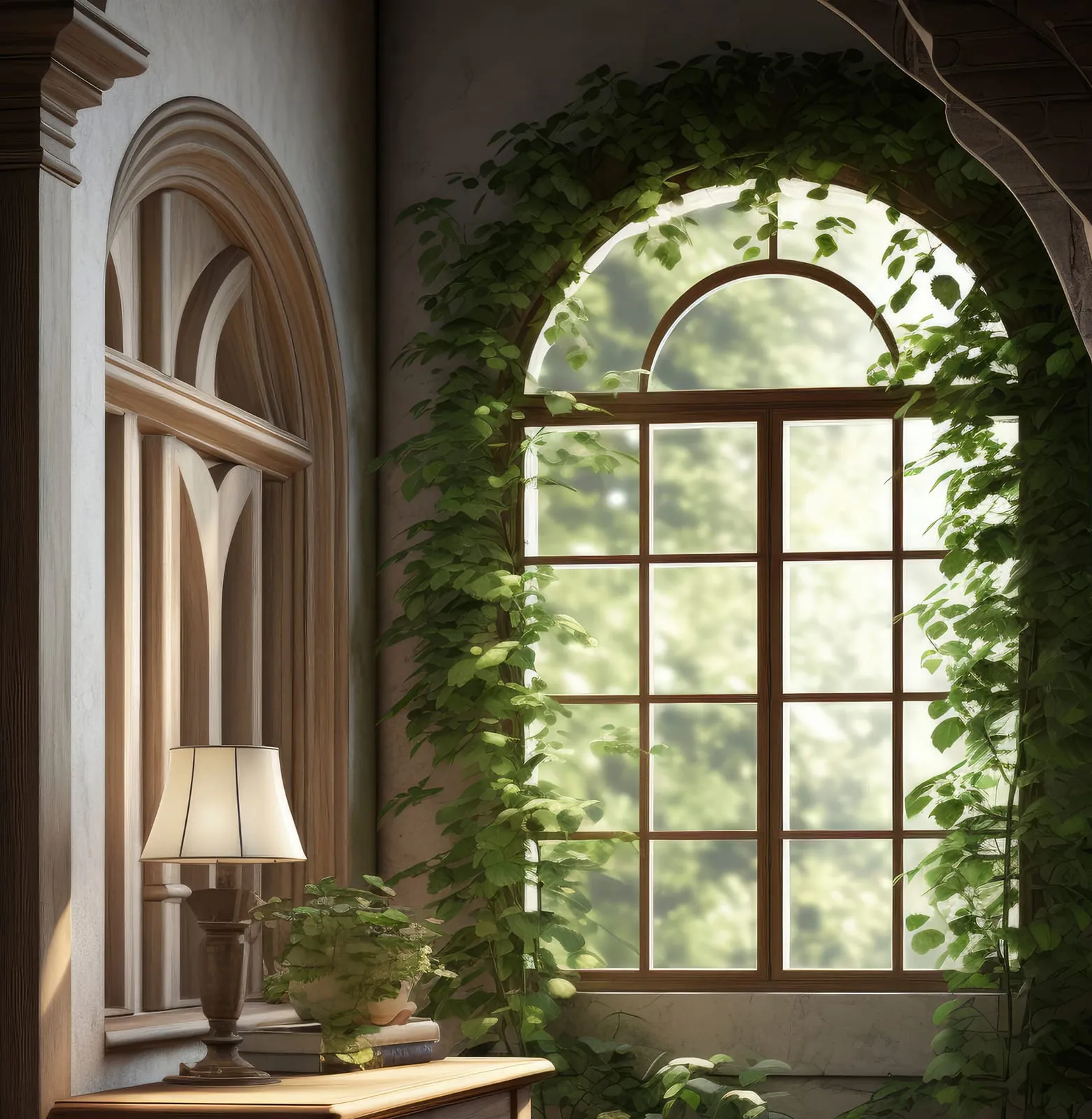
Three arched head shapes
Full arch (semicircular). The radius equals half the opening width, giving a true half-circle head. It needs real height above the opening and is the most formal of the three.
Segmental arch. A shallower curve struck from a radius larger than half the width. Much more common in practice, because it works where there is less headroom, and it sits comfortably on a wider range of elevations.
Eyebrow. A gentle rise over an essentially flat head. Subtle — it softens a rectangular opening without announcing itself.
Which one is right is usually decided by the masonry you already have, not by preference. In a replacement, we template the existing opening.
How the frame is made
An arch cannot be cut from a straight length. uPVC profiles are heated and bent to the radius, then welded; aluminium is rolled. Either way the radius is specific to your opening, which is why arched windows are always made to order and why the survey matters more than usual.
Old openings are also rarely true curves. Settlement, replastering and the original mason’s hand all mean the arch you measure is not the arch on any drawing. We template it on site so the frame follows the opening rather than fighting it.
Fixed head, opening below
Most arched windows in practice are a fixed arched light over an opening section:
- a casement pair below for ventilation and sealing
- or a sliding section where there is no swing space
The arch itself is usually high on the wall, where an opening light would be awkward to reach and of limited use. Keeping it fixed also gives the best possible seal and the slimmest sightlines in the part of the window you look at most.
Glass and glazing bars
Curved glass is expensive; in nearly all cases the head is glazed with flat panes cut to the arc, which is visually identical from inside a room.
Radiating glazing bars — spokes from the springing point — are the traditional treatment and are what make an arch read as an arch rather than as a curved-top window. They can be genuine divisions or applied bars over a single sealed unit, which keeps the thermal performance of double glazing while preserving the pattern.
Where arched windows work
Stairwell half-landings, double-height living rooms, entrance elevations, and anywhere a heritage building’s rhythm needs to be kept. They also do real work in a compact flat: an arched head above a standard opening pushes daylight higher up the room and makes a low ceiling read as taller.
For openings that are neither rectangular nor arched, see customised window designs. For the full range of shapes and operations, see window types.
Send a photo of the opening with a tape measure across the widest point and the height at the centre, and we can tell you which arch you have.