
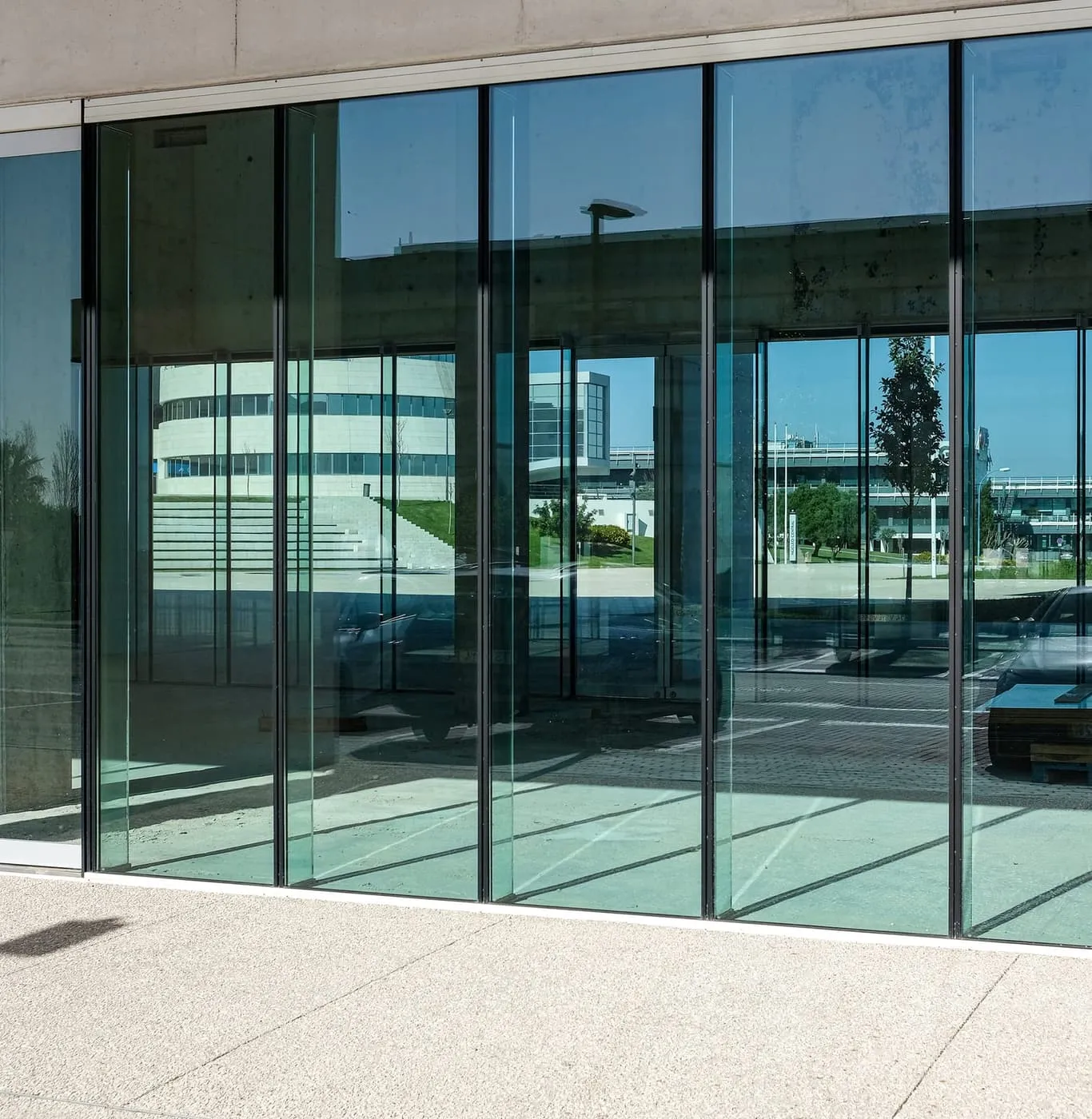
How it works
Two or more panes of glass are bonded to a plastic interlayer — usually PVB, sometimes SGP for structural applications — under heat and pressure. The result behaves as a single pane until something breaks it.
When it does break, the glass cracks but the fragments remain bonded to the interlayer. The pane holds its shape, stays in the opening, and continues to act as a barrier. That single behaviour is the basis of everything else laminated glass is used for.
Four benefits from one construction
Impact safety
No falling shards, no gap left in the opening. This is why laminated glass is required overhead and is the sensible choice at low level in a home with children.
Security
An intruder has to break through both glass plies and the interlayer, which takes time, force and noise. Most opportunistic break-ins are abandoned at that point. See security glass windows in Mumbai for the fuller picture.
UV blocking
The interlayer absorbs around 99% of ultraviolet light. In a west-facing Mumbai room, that is the difference between flooring and upholstery that hold their colour and ones that do not.
Worth being clear: this is UV, not heat. Solar heat gain needs a coating, which can be combined with lamination in the same sealed unit.
Acoustic damping
The interlayer is viscoelastic, so it absorbs vibration energy instead of transmitting it. A laminated pane is measurably quieter than a monolithic pane of the same weight, which is why the inner leaf of a good acoustic unit is nearly always laminated. See soundproof windows.
Laminated, toughened, or both
Toughened (tempered). Heat-treated to several times the strength of annealed glass, and it granulates when broken. Great for impact resistance; useless once broken, because it leaves the opening.
Laminated. Not as strong, but stays in place after breaking.
Laminated-toughened. Toughened plies bonded to an interlayer. Strong and it stays put. This is the specification for balustrades, overhead glazing and serious security work.
Where to specify it
- Full-height and low-level glazing, and balcony doors
- Anything overhead — skylights, canopies, atrium roofs
- Glass railings and balustrades, without exception
- Ground and first-floor windows where security matters
- Rooms facing a main road, as the inner leaf of an acoustic unit
- Rooms with valuable flooring or art, for the UV
In a sealed unit
Laminated glass is usually one leaf of a double-glazed unit rather than a standalone pane — typically the inner leaf, with a coated outer leaf handling solar control. That build gives you safety, security, UV protection, acoustic damping and heat rejection in a single window.
See glass options for the full range, or tell us what the room faces and what you are trying to solve, and we will specify the build.