
How it works
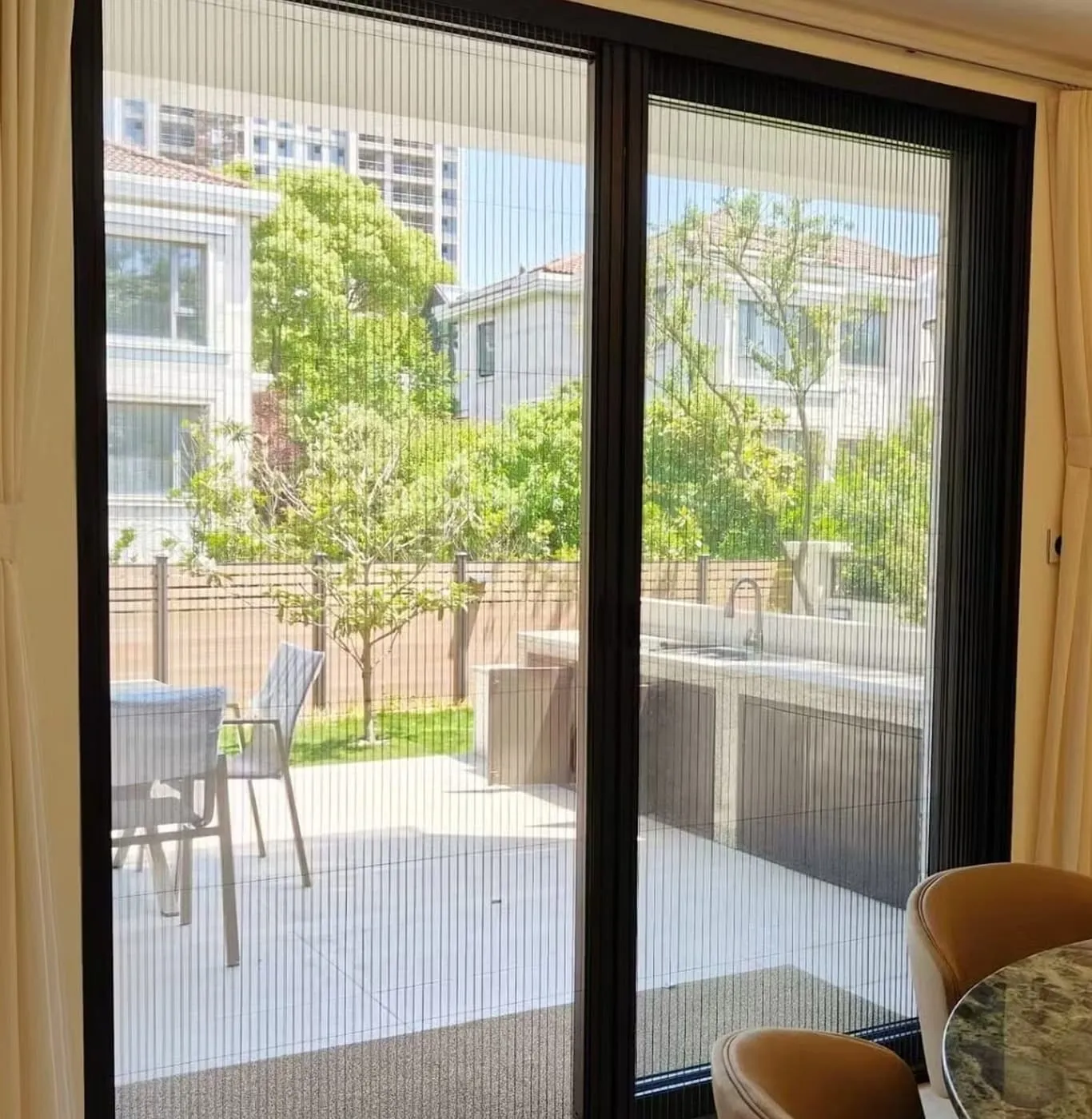
A mesh panel in its own slim frame runs horizontally in a track, exactly like a glazed sash. You slide it across to cover whatever part of the opening is open, and park it out of the way when you do not need it.
On a sliding window or sliding door, this is the natural pairing — the screen works the same way the window does, so using it requires no thought.
Designing it in
The neatest installations are the ones planned at the point of ordering the window.
A three-track system gives two glazed sashes plus a dedicated screen channel. A four-track gives more glass and still leaves a channel. In both cases the screen runs within the window frame itself, so from outside there is no separate screen frame at all.
Retrofitting to a two-track window is possible but different: with no spare channel, the screen has to be mounted in its own frame over the reveal. It works, and it is visibly an addition.
This is why we ask about screens when specifying windows rather than afterwards.
Why framed beats retractable here
A framed panel is a rigid object. It does not crease, it does not need a spring mechanism, and it tolerates being pushed — by a child, a pet, or a gust.
On a balcony door used several times a day, that robustness is the main argument for a sliding screen over a pleated or pull-down system. Retractable screens are neater when stowed; framed screens last better when used.
Cleaning
Lift the panel out of the track and wash the mesh with water and a soft brush. Twice a year is reasonable in Mumbai; more on a road-facing elevation where dust builds quickly.
This is genuinely easier than cleaning a retractable screen, which has to be cleaned in place while extended.
Track maintenance
The screen track collects dust exactly like the glazing track beside it. Keep it clear so the panel runs easily, and check that any drainage in the sill is not blocked — the same principle that applies to the window itself.
When something else suits better
Outward-opening sashes. A sliding screen needs a track, which a casement window does not have. Use pull-down or pleated instead.
Very wide openings. Beyond a certain width a single framed panel becomes heavy and unwieldy. Zig-zag mesh is engineered for those spans.
Where the mesh must disappear. If you want no visible screen at all when it is not in use, a retractable system is the answer. See the full insect screen range.