
Skip to content
Khidkiji Slides India

Horizontal Wire Invisible Grills

Horizontal cables run from jamb to jamb rather than floor to soffit. They suit openings where the side structure is stronger than the soffit, and wide shallow runs where vertical anchors would be awkward — with one important caveat about children.

  • Manufacturing since 2007
  • 5,000+ windows installed
  • 219 corporate partners
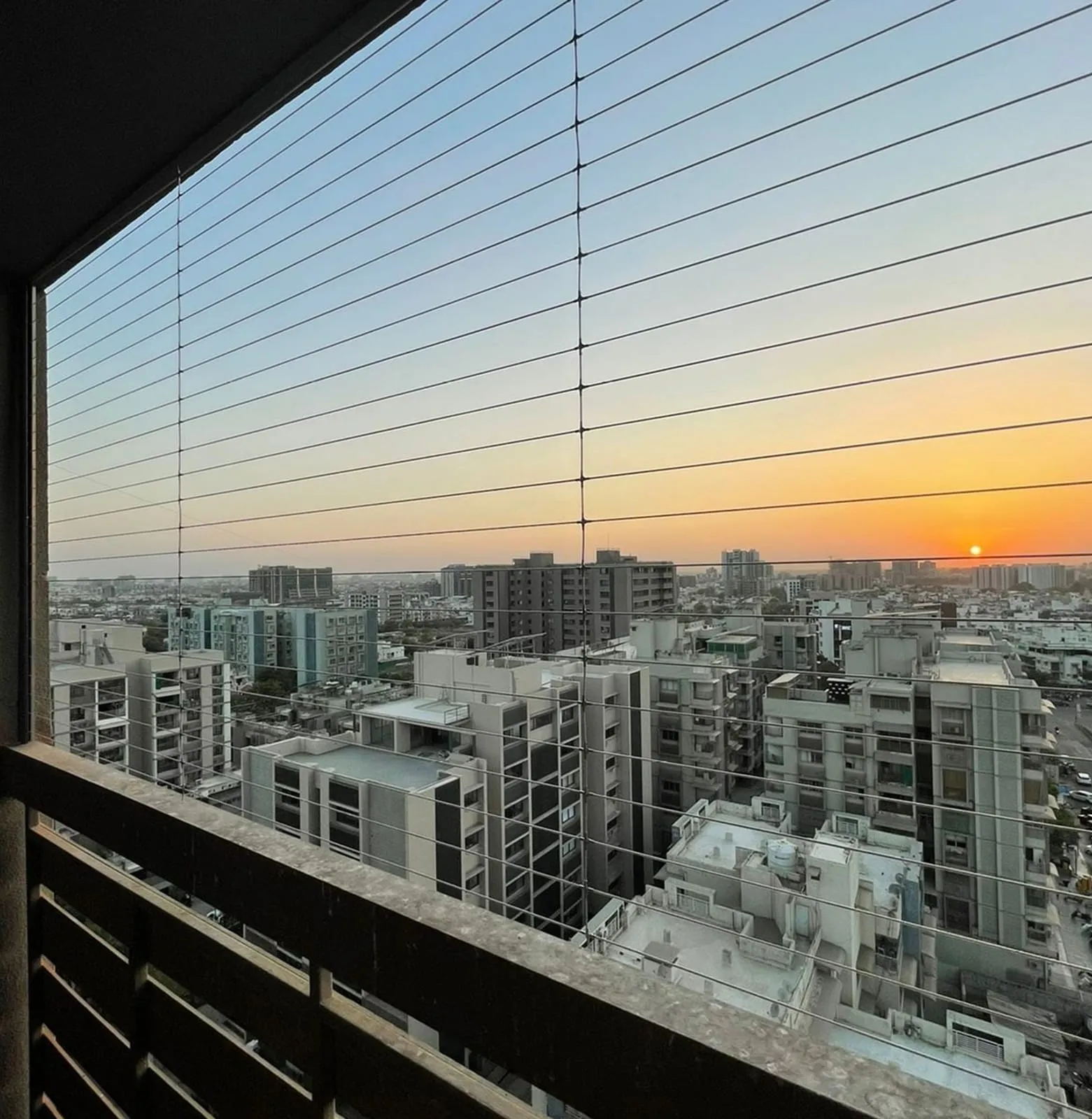
Balcony rail with horizontal steel cables strung across it, city rooftops at sunset behind

Get a quote in one working day

Three fields. No obligation.

Or call +91 80979 88888

Why horizontal wire invisible grills

Anchors at the jambs

Useful where the soffit is unsound or inaccessible but the flanking walls are solid structure.

Suits wide, shallow openings

One anchor point at each end of a long run, rather than a fixing every few centimetres along the slab.

Fewer penetrations

Fewer fixings into the structure overall, which matters where the slab edge has already been repaired.

Matches horizontal architecture

Reads with the lines of a balcony parapet rather than across them, which some elevations want.

When horizontal is right

No usable soffit. An open terrace or a parapet with nothing above it gives a vertical layout nothing to anchor into at the top. Horizontal cables between the flanking walls solve that directly.

A damaged or repaired slab edge. Where the top of the parapet or the edge of the slab has been repaired, drilling a fixing every few centimetres along it is unwise. A horizontal run needs anchors only at each end plus any intermediate posts.

Wide, shallow openings. A long low run is naturally suited to cables spanning its length.

The elevation wants horizontals. Some balconies read better with lines following the parapet rather than crossing it.

The caveat, stated plainly

Closely spaced horizontal cables can act as a ladder. A determined small child can get a foot on one and then another.

If the reason for fitting a grill is a toddler, this matters more than appearance, and we will recommend vertical wires or cable mesh instead. Both remove the foothold entirely.

Where the horizontal look is wanted and children are a factor, a mixed layout works: vertical cables up to about a metre, horizontal above. It costs a little more to install and it resolves the problem properly.

Span, sag and intermediate posts

A cable under tension between two points always deflects slightly under load, and the longer the span the more tension is needed to control it. Past a certain span, the tension required starts to load the end anchors more than they should carry.

The answer is an intermediate post or stanchion partway along. This is a design decision made at survey — running a very long horizontal span on end anchors alone is how systems end up sagging within a year.

Anchoring

The flanking walls have to be sound structure, not masonry infill or plaster over a light partition. On a Mumbai balcony, the side wall may be a shared party wall or a lightweight enclosure added later.

We check what the anchors will actually land in rather than assuming, and where the jambs will not take the load, a framed system provides its own fixing points.

Materials

Marine-grade stainless for cable, anchors, tensioners and end fittings — the same requirement as every other system in the invisible grill range. Coastal air finds the hardware long before it touches the cable.

Access

If part of the run needs to open — for cleaning the glazing behind, or for access to a utility — a sliding section can be built into a horizontal layout.

Common questions

Are horizontal invisible grills safe with children?

This is the honest caveat: closely spaced horizontal cables can give a climbing child footholds in a way vertical cables cannot. Where small children are the reason for fitting a grill, we recommend [vertical wires](/products/invisible-grills/vertical-wire/) or [cable mesh](/products/invisible-grills/cable-mesh/) instead.

When are horizontal wires the better choice?

When the soffit is unsound, inaccessible or absent — an open terrace parapet with no slab above, for instance — and the flanking walls are solid. Also on wide shallow runs, where jamb-to-jamb cables need far fewer fixings than a vertical layout would.

How is sag prevented over a long horizontal run?

Through tension and intermediate supports. Beyond a certain span, cables need an intermediate post or stanchion, otherwise the tension required to keep them straight becomes very high. That span limit is part of the design rather than something discovered later.

Do horizontal grills block the view more than vertical ones?

Marginally, and it depends on the outlook. Against a horizon or a low skyline, horizontal cables can cut across the view more noticeably. Against a dense vertical cityscape the difference is small.

Can horizontal and vertical be combined?

Yes, and it is sometimes the right answer — vertical cables in the zone a child can reach, horizontal above. It is more work to install but it resolves the climbing concern without losing the look on the upper part of the run.

Related

Get a quote for horizontal wire invisible grills

  • Manufacturing since 2007
  • 5,000+ windows installed
  • 219 corporate partners
Call nowWhatsApp